Table of Contents
A home elevator is a residential mobility solution designed to help people move safely and comfortably between floors. It is commonly used by seniors, individuals with limited mobility, and homeowners who want to improve accessibility or future-proof their space. Choosing the right type of home elevator depends on factors like available space, budget, installation requirements, and long-term needs.
In this guide, we will walk through the different types of residential elevators, how they work, and what to consider when deciding which option is right for your home.
Why Are Home Elevators Becoming More Popular?
Home elevators are no longer considered a luxury feature reserved for large estates. More homeowners are installing them to support aging in place, reduce fall risk, and make everyday movement easier.
According to the Centers for Disease Control and Prevention, falls are the leading cause of injury among older adults, which makes safe mobility solutions an important investment in long-term health and independence. Residential elevators have features like emergency stop buttons, backup power systems, door interlocks, and smooth start and stop mechanisms that help create a secure ride.
Beyond safety, home elevators can also add convenience and increase property value, especially in multi-story homes. With proper installation and maintenance, they can be a practical long-term solution that improves safety, convenience, and confidence at home.
The 4 Main Types of Elevators for Homes
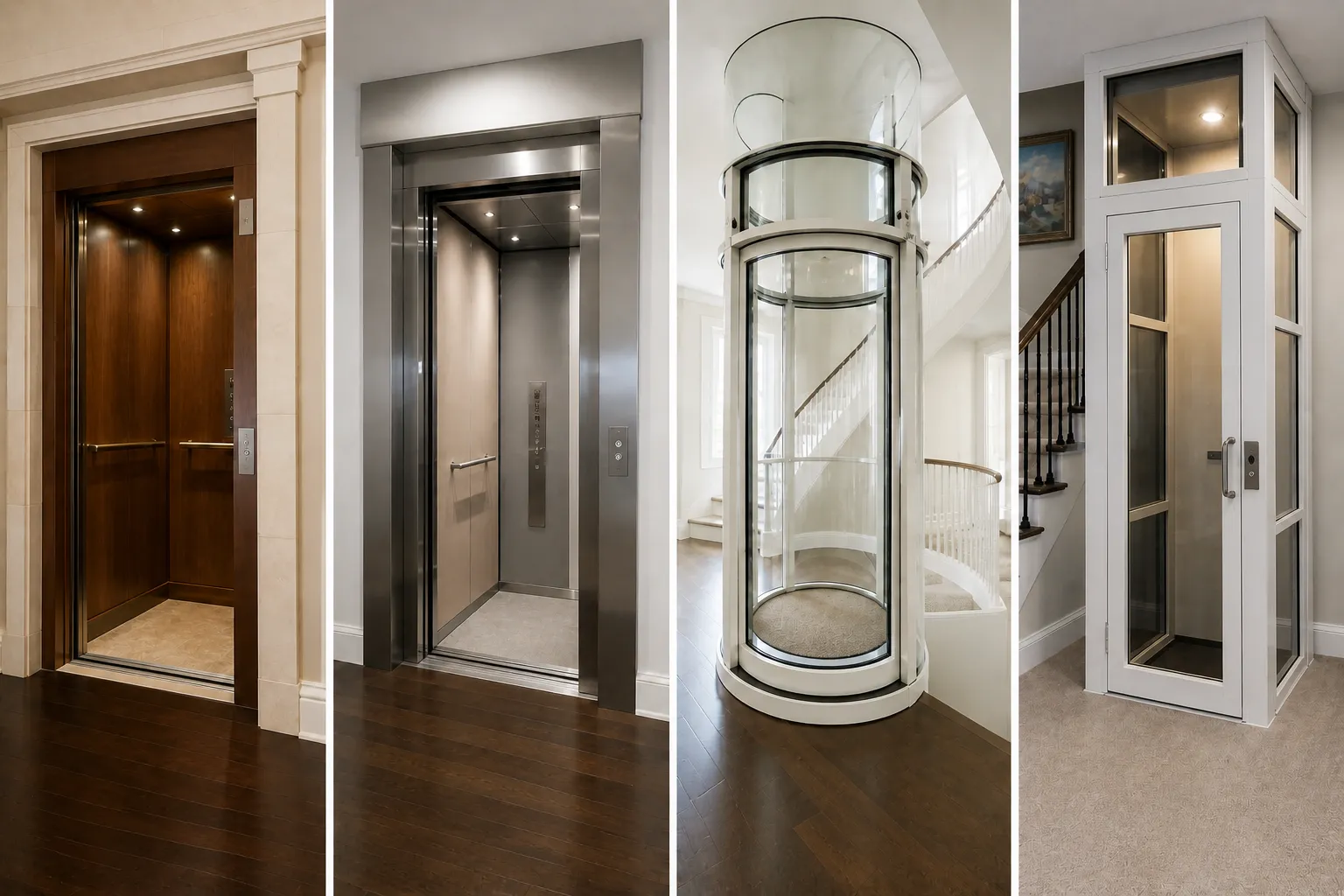
There are several types of residential elevators available today. Each one uses a different system to move between floors, and each comes with its own advantages.
1. Hydraulic Home Elevators
Hydraulic elevators are one of the most traditional and widely used types. They use a fluid-driven piston to move the cab between floors. A pump pushes oil into a cylinder, which raises the elevator. The fluid returns to a reservoir to lower the cab. Hydraulic systems work well in larger homes where ride quality and weight capacity are priorities.
Pros:
- Very stable and reliable
- Smooth, quiet ride
- Higher weight capacity
Cons:
- Machine room or extra space required
- Higher installation cost compared to other types
2. Traction or Cable-Driven Elevators
Traction elevators use steel cables and a counterweight system to move the cab. An electric motor turns a sheave, which pulls the cables. This design is highly efficient and can serve multiple floors without the height restrictions of hydraulic systems. Many modern traction systems use a machine-room-less configuration, which saves space by placing the motor inside the shaft. These elevators are common in both residential and commercial settings.
Pros:
- Energy efficient
- Does not require as much space as hydraulic systems
- Offers a comfortable ride
Cons:
- May cost more upfront
- Complex installation
- Can be slightly noisier depending on the system
3. Pneumatic Vacuum Elevators
Pneumatic elevators use air pressure to move a cylindrical cab smoothly through a vertical tube. A vacuum pump at the top creates controlled pressure differences to lift and lower the cab, eliminating the need for cables, pistons, or oil. With their compact footprint and sleek cylindrical design, they offer a modern, visually striking solution that works well in homes with limited space or in retrofit projects where traditional elevator systems may not fit.
Pros:
- Minimal construction required
- Space-saving design
- Sleek and modern appearance
Cons:
- Limited weight capacity
- Typically smaller cab size
- May not be ideal for wheelchairs, depending on the model
4. Shaftless Home Elevators
Shaftless elevators travel through an opening in the floor without the need for a full elevator shaft. They are self-contained units that move between two to four stops using a guided rail system. Shaftless models are ideal for homeowners who need vertical access but cannot accommodate a traditional shaft. They are well-suited for retrofit projects where minimizing structural changes is a priority.
Pros:
- Easy to install
- Requires less construction and home modifications
- Cost-effective option
Cons:
- Limited to two floors in most cases
- Smaller size may not accommodate all mobility needs
Key Factors to Consider When Choosing a Home Elevator
- Space and Layout: Some systems need a dedicated shaft, pit, or machine room. Others can be installed with minimal structural changes. The existing floor plan, ceiling height, and wall structure will determine which types are feasible.
- Weight Capacity Needs: Standard residential elevators typically support between 500 and 1,000 pounds. Households that need to accommodate wheelchairs, multiple passengers, or heavy medical equipment should select a model with adequate capacity.
- Budget: Costs vary widely depending on the type of residential elevator and the amount of structural work required. Shaftless and pneumatic models often cost less to install because they need fewer modifications. Hydraulic and traditional traction systems may require more extensive construction.
- Installation Time: Some elevators can be installed in a matter of days, while others require more extensive construction.
- Long-Term Maintenance Requirements: Hydraulic systems need periodic fluid checks and seal inspections. Traction systems require cable inspections and lubrication. Pneumatic and shaftless models generally have lower maintenance demands.
Choose the Right Type of Residential Elevator for Your Home and Needs
With several types of home elevators available, the best choice depends on your home, mobility needs, budget, and long-term goals. Some homeowners need a compact solution for a tighter space, while others may need a larger elevator with greater weight capacity or added convenience for aging in place.
At Western Stairlifts, we help you evaluate your space, compare your options, and choose a home elevator that fits your space and mobility needs. With a typical installation turnaround of 4 to 6 weeks, our team makes the process simple and faster, from consultation to completion. Contact us today to schedule your free in-home evaluation and find the right home elevator for your home.