Table of Contents
- Cold Weather Is Rarely the Problem. Water Is.
- The Cover Earns Its Keep
- Park It Where It Charges
- What to Put on Your Steps, and What to Skip
- Sunken Stairwells Need a Drain Plan
- A Five Minute Check Before the First Storm
- If the Lift Stops in Cold Weather
- Frequently Asked Questions
- Can an outdoor stairlift stay outside all winter?
- Do I need to take the seat inside?
- Will the lift still work if the power goes out?
- What kind of ice melt is safe to use around the lift?
- Is it too late in the year to install an outdoor stairlift?
- Should I choose an outdoor stairlift or a vertical platform lift?
- The Bottom Line
Short answer: yes. An outdoor stairlift is built for exactly this. The Atlas Outdoor Stair Lift has a sealed, weatherproof motor rated for all seasons, a corrosion resistant aluminum rail with a UV resistant coating, and an all weather cover included with the unit.
The longer answer is that we still get calls in January about outdoor lifts that have quit, and almost none of them are about the cold itself. They are about water, ice, and where the snow ended up. Here is what actually decides whether your lift runs from the first storm to the last one.
Cold Weather Is Rarely the Problem. Water Is.
The motor is sealed and the rail is coated. Freezing air, on its own, is not what stops an outdoor lift.
What stops it is water that gets somewhere, then freezes. Snow melts on a sunny afternoon, runs down the rail, and refreezes overnight as a thin glaze the carriage then has to climb. Snow gets packed onto the track by a shovel or a boot and compresses into ice. Leaves and grit wash into the track in the fall and freeze in place.
None of that is a defect. It is what happens to any piece of equipment mounted on exterior stairs in a climate like ours, and it is almost entirely preventable with a few habits.
The Cover Earns Its Keep
Every outdoor unit ships with an all weather cover, and in our experience it is the single biggest difference between a lift that runs all winter and one that needs a service call.
The failure pattern is predictable. People cover the lift diligently in summer, stop in October because it has not snowed yet, and then the first real storm lands on an uncovered seat and carriage. The seat gets soaked, the cushion freezes, and meltwater works into places it should not be.
Make it the same habit as locking a door. The lift gets used, the lift gets covered. It takes about fifteen seconds.
Park It Where It Charges
Outdoor stairlifts run on batteries that recharge at park points on the rail, and the battery backup keeps the lift running through a power outage, which in a Utah or Idaho winter is exactly when you need it most.
Two things are worth knowing. First, batteries deliver less in the cold than they do in mild weather, so the margin you have in July is not the margin you have in January. Second, a lift left parked away from its charge point slowly drains, and a week of cold on top of that can leave you with a lift that will not move on the morning you need it.
Return it to its park position every single time. That one habit covers both problems.
What to Put on Your Steps, and What to Skip
This is the part people get wrong most often, and it does real damage.
Skip the ordinary rock salt. Rock salt and calcium chloride are hard on aluminum, and the rail, the footrest, and the mounting hardware are all aluminum. You will not see it the first winter. You will see it in year four as pitting and white corrosion around the fasteners.
Use a pet safe ice melt instead. It is what we tell every customer to buy. It actually clears the ice, which matters on steps you are about to ride a lift down, and it does not attack the aluminum the way rock salt does.
Use a plastic shovel, not a metal one. A steel blade catches the rail and gouges the coating, and once the coating is broken the aluminum underneath starts to weather.
Keep a bag of pet safe ice melt and a plastic shovel by the door before the first storm, and the temptation to grab whatever is in the garage goes away.
Sunken Stairwells Need a Drain Plan
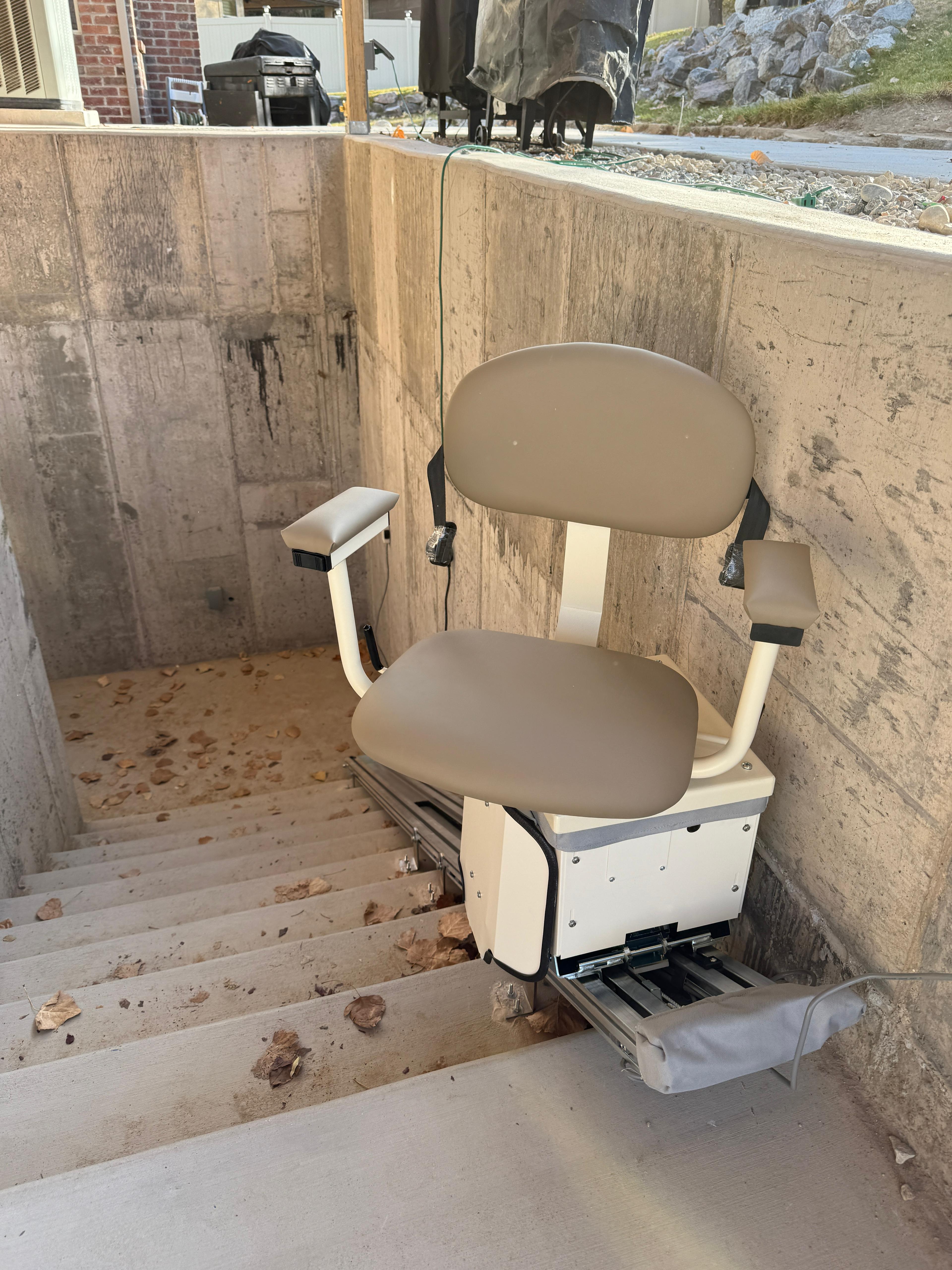
If your lift runs down into a below grade stairwell, the kind that drops from a patio to a basement door, pay attention to this one. It is the most common outdoor lift problem we see in a Utah winter.
An exterior stairwell below grade is a bucket. Drifting snow lands in it and does not blow back out. When that snow melts, the water has exactly one way to leave, and that is the drain at the bottom. If the drain is packed with leaves from October, the water sits, and then it freezes, and now the bottom of your rail and the carriage parking position are in a block of ice.
Clear that drain in the fall. Check it again after the leaves finish dropping. It takes two minutes and it prevents the single most expensive version of this problem.
A Five Minute Check Before the First Storm
Run through this once, now, while the weather is still easy:
- Clear leaves, grit, and debris off the full length of the rail and out of the track
- Check the stairwell drain if you have one, and clear it properly rather than poking at the top
- Run the lift from the bottom to the top and back, and listen for any hesitation or new noise
- Confirm it returns to its charge point and seats properly
- Inspect the cover for tears and check that it still fastens properly
- Put a bag of pet safe ice melt and a plastic shovel where you will actually reach for them
If anything on that list feels off, it is far easier to sort out in October than in a January storm.
If the Lift Stops in Cold Weather
Do not force it. Running a carriage against a frozen obstruction is how a nuisance becomes a repair.
Check the simple things first. Is it seated on the charge point? Is the key switch on? Is there visible ice in the track or snow packed under the footrest? If the rail is glazed over, let it thaw rather than trying to power through, and clear the track by hand once it does.
If it still will not run, get in touch and we will work out whether it is something you can clear yourself or something we need to come look at. Our regular stairlift maintenance guidance covers the year round basics too.
Frequently Asked Questions
Can an outdoor stairlift stay outside all winter?
Yes. Outdoor units are designed to be permanently mounted outside, with sealed motors and weather rated components. They are not brought in seasonally. Keeping the cover on when the lift is not in use is what keeps that design working as intended.
Do I need to take the seat inside?
No. The seat is part of a weather rated unit and is meant to stay on the rail. The cover is what protects it, which is why the covering habit matters more than anything else on this list.
Will the lift still work if the power goes out?
Yes. Outdoor stairlifts run on batteries with the charger topping them up at the park points, so a power cut does not strand you mid flight. This is a bigger deal in winter than in summer, since outages and storms tend to arrive together.
What kind of ice melt is safe to use around the lift?
Use a pet safe ice melt. Ordinary rock salt and calcium chloride corrode aluminum over time, and the rail and hardware are aluminum. The pet safe versions clear ice properly without doing that damage, which is why we recommend them to every customer.
Is it too late in the year to install an outdoor stairlift?
Usually not. An outdoor stairlift mounts to the steps rather than the walls, so there are no wall modifications to schedule around, and a typical install runs about three to four hours. The limiting factor is getting the site looked at and the rail ordered, so the earlier in the fall you start, the more comfortable the timeline.
Should I choose an outdoor stairlift or a vertical platform lift?
It depends on whether the person using it can transfer to a seat, and on how much vertical rise you are dealing with. We compared the two in detail in outdoor stairlifts versus vertical platform lifts for exterior access.
The Bottom Line
An outdoor stairlift will run through a Utah or Idaho winter. It is built to. What decides whether yours does is unglamorous: keep the cover on, park it on the charger, use a pet safe ice melt rather than rock salt, keep metal shovels away from the rail, and make sure meltwater has somewhere to go.
Spend five minutes on it now, before the first storm, and the lift becomes something you stop thinking about. If you would rather have someone look at your stairs and tell you what winter is going to do to them, book a free in home evaluation and we will walk it with you.