Table of Contents
A stair lift that will not move feels like a breakdown. Most of the time it is not one.
We take these calls year round, and the majority are resolved on the phone in a few minutes without anyone coming out and without a part being replaced. The lift is working exactly as designed. Something is telling it not to run, and once you know where to look, it is usually obvious.
Here is the same checklist we walk people through, in the order we actually ask about it.
Start With the Six Things That Cause Most Calls
Work down this list before anything else. One of these is the answer far more often than not.
Is it parked on its charge point? Stair lifts run on batteries, and the batteries only recharge when the carriage is sitting on a charge point, usually at the top or bottom of the rail. A lift left parked halfway up the stairs is not charging. Leave it there for a few days and it will run flat. This is the single most common cause we see.
Is the key switch or isolation switch on? Most lifts have a key switch on the carriage and a separate power switch or plug for the charger. Either one can get knocked, switched off during cleaning, or turned off by someone being careful and then forgotten.
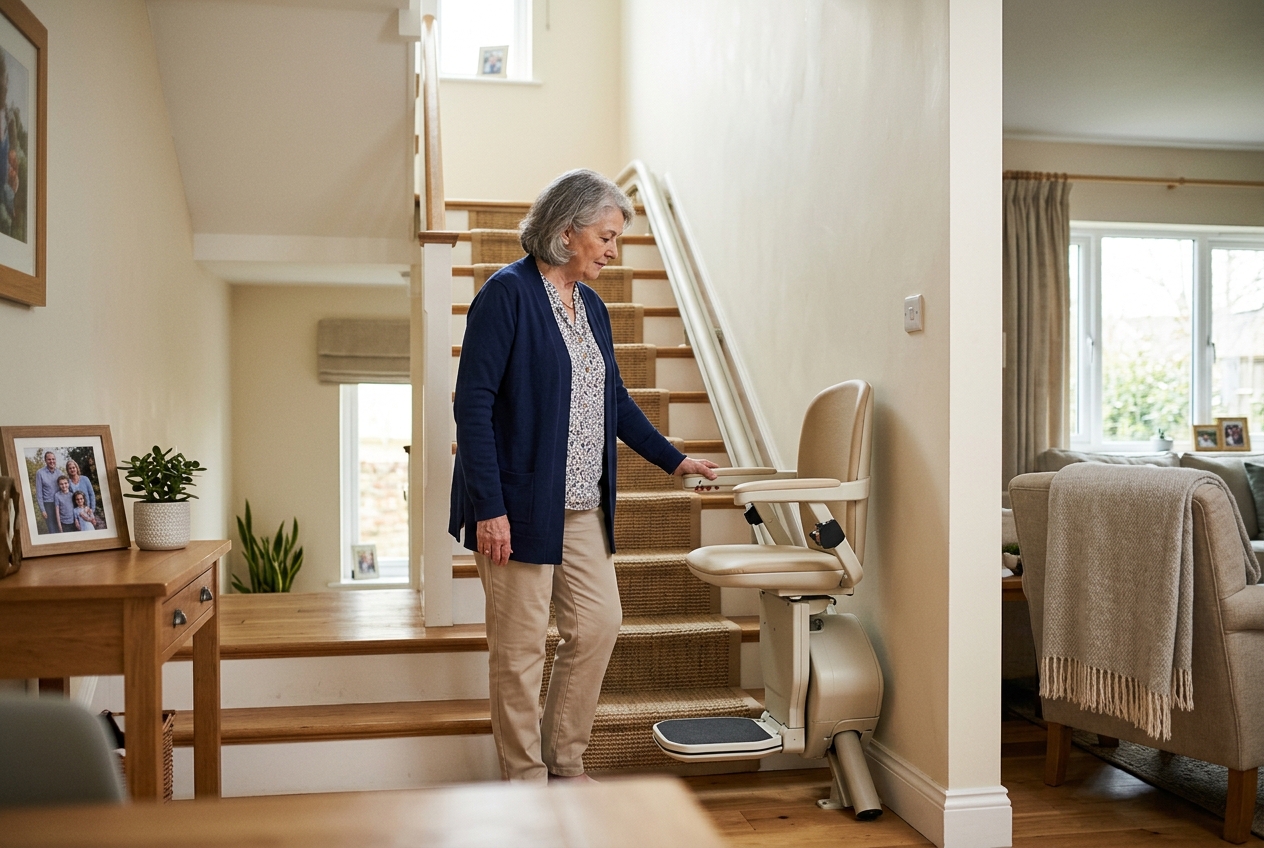
Is the seat fully swivelled back into position? The seat swivels at the top so you can get off facing the landing, and there is a safety interlock that stops the lift running unless the seat is locked square to the rail. If it is sitting even slightly off its detent, the lift will not move. Swivel it firmly until it clicks.
Is the footrest folded all the way down? The footrest has its own interlock on most models. Half down counts as not down.
Is anything touching the track? Obstruction sensors sit around the footrest and the carriage, and they are deliberately sensitive. A shoe, a laundry basket, a pet toy, a rucked up stair runner or a trailing phone charger is enough to stop the lift and keep it stopped.
Has the power to the charger gone? Check the socket the transformer plugs into and check your breaker panel. A tripped breaker on that circuit is easy to miss, because the lift keeps running on battery for a while afterwards and only fails days later when the battery is flat.
What the Beeping Usually Means
A stair lift that beeps steadily, or beeps when you park it, is almost always telling you about the battery rather than a fault.
The usual cause is that it is not making contact with the charge point. Sometimes the lift has not quite reached the park position. Sometimes the charging contacts have a film of dust or carpet fluff on them. Running the lift fully onto the charge point and leaving it there for several hours clears most of these.
If it has been parked properly on the charger overnight and still beeps, the batteries are likely at the end of their life. Stairlift batteries are a wear item. They do not last forever, and replacing them is a routine job rather than a major repair.
If It Stopped Partway Up the Stairs
Do not force it, and do not try to push the carriage along the rail by hand.
Check for an obstruction around the footrest and under the seat first, since that is the most likely reason it halted mid travel. Clear anything you find, then try the directional control again.
Most lifts also have a manual lowering option so the carriage can be brought back down gently. If you have the manual, it will be in there. If you do not, call us and we will talk you through it rather than having you guess.
The thing to avoid is repeatedly pressing the control against a lift that will not move. If something is physically in the way, forcing it is how a five minute fix becomes a real repair.
When It Only Runs One Direction
This one confuses people, and it is usually not a fault at all.
Stair lifts have limit switches at each end of the rail that stop the carriage at the top and bottom. If the lift thinks it is already at the end of its travel, it will refuse to go further in that direction while still running happily the other way. A carriage sitting slightly past a limit switch, or a switch with something lodged against it, produces exactly this behaviour.
Low battery can also do it, because going up draws considerably more power than coming down. A lift with a weak battery will often still descend while refusing to climb. If your lift goes down but not up, check the charging situation before assuming the motor has failed.
What Not to Do
Three things are worth being clear about.
Do not remove covers or panels. There is mains voltage inside the carriage and the charger, and the covers are not meant to come off outside of a service visit.
Do not attempt electrical work on the charger or its wiring. Checking that a plug is in and a breaker is on is fine. Anything beyond that is not.
Do not keep operating a lift that is making a new noise. Grinding, scraping or a change in pitch means something mechanical wants looking at, and continuing to run it tends to make the eventual repair larger.
The Winter Version of This Problem
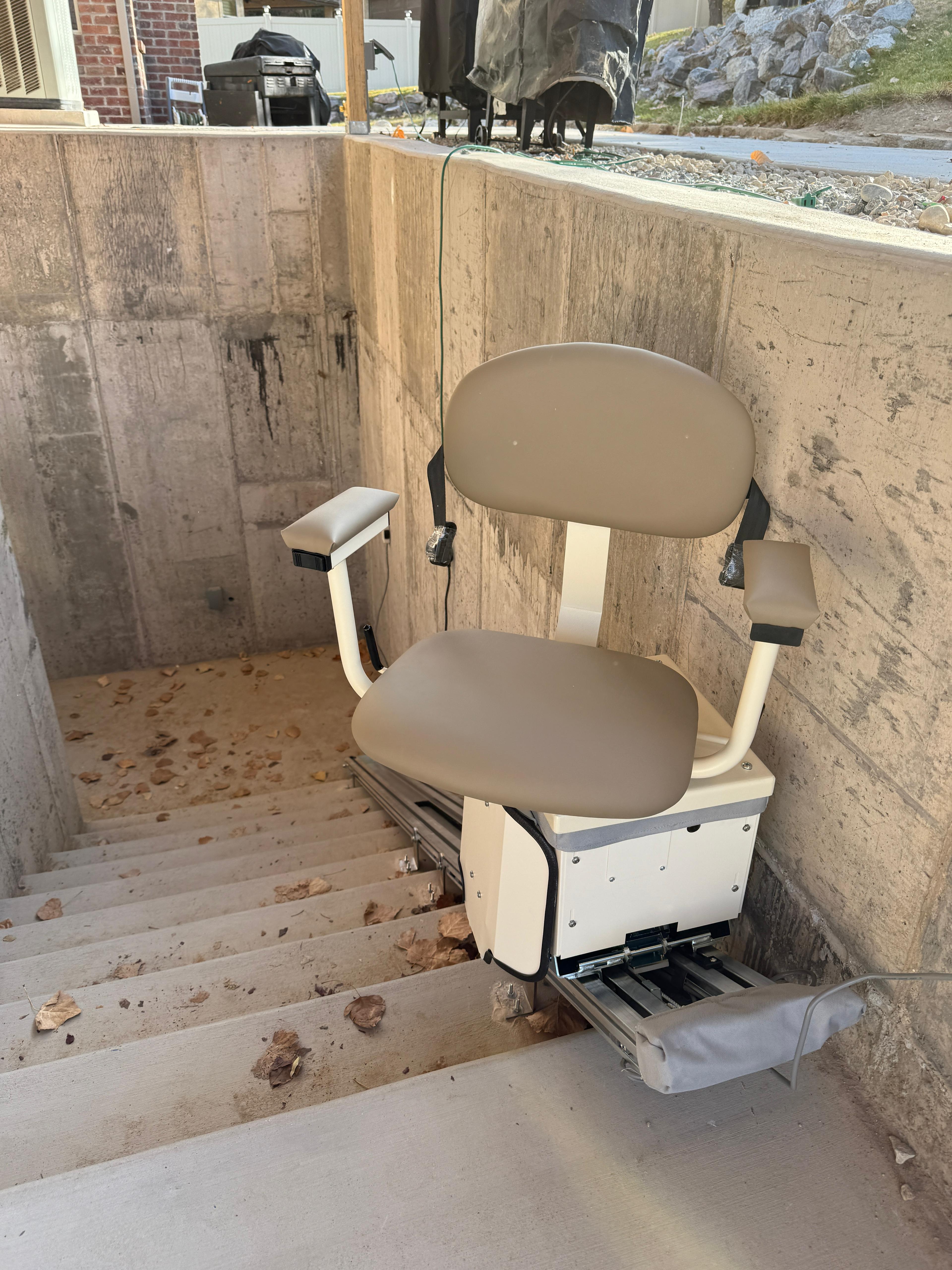
If you have an outdoor stairlift, cold weather adds causes that do not apply indoors, and most of them come down to water rather than temperature.
Ice in the track, snow packed under the footrest, and a carriage that has been sitting off its charge point in freezing weather all produce a lift that will not run. Batteries also deliver less in the cold, so a battery that was marginal in September becomes a problem in January.
We went through the whole seasonal picture in the outdoor stairlift winter post, including the ice melt question, which matters more than people expect.
Repair or Replace?
If a lift is genuinely faulty, the next question is whether fixing it is the right call.
Batteries, controls, chargers and worn carriage components are all routine replacements on a lift that is otherwise sound, and the economics are usually straightforward. Rails and drive systems are a different conversation. On an older unit, particularly one that came with the house and has no service history, the repair can approach the cost of a reconditioned stairlift that comes with a warranty and a known history.
We will tell you honestly which side of that line you are on. A repair that buys two more years on a tired lift is often the wrong purchase, and we would rather say so.
Most of This Is Preventable
Nearly every avoidable call we take traces back to the same handful of habits.
- Return the lift to its charge point every time, not just at the end of the day
- Keep the stairs and the track clear, including the stair runner edges
- Wipe the charging contacts occasionally if the house is dusty or you have pets
- Book an annual service and actually keep it
- Replace batteries when they start showing their age rather than waiting for a failure
Our stairlift maintenance guidance goes through the year round routine in more detail.
Frequently Asked Questions
- Why is my stair lift beeping? Usually because it is not charging. Either the carriage is not fully seated on its charge point, or the charging contacts are dirty, or the batteries have reached the end of their life. Park it properly on the charger and leave it for several hours. If it still beeps the next morning, the batteries are the likely answer.
- My stair lift stopped halfway up the stairs. What do I do? Check for an obstruction around the footrest and under the seat, clear it, and try again. Do not force the control and do not push the carriage along the rail. Most lifts have a manual lowering method to bring the carriage down gently, and we can talk you through yours over the phone.
- Why does my stair lift go down but not up? Most often a weak battery, because climbing draws far more power than descending. It can also be a limit switch if the carriage is sitting right at the end of its travel. Check the charging situation first.
- Does a stair lift still work during a power cut? Yes. Stair lifts run on battery with the charger topping them up, so a power cut does not strand the lift. What it does mean is that the batteries stop being replenished, so a long outage will eventually drain them.
- How often should a stair lift be serviced? Once a year for normal household use. A lift that gets heavy daily use, or one mounted outdoors, benefits from being looked at more often. Annual servicing is also what keeps small wear items from turning into breakdowns.
- Is it worth repairing an older stair lift? It depends what has failed. Batteries, chargers and controls are routine and usually worth doing. Rail and drive problems on an old unit with no service history are where a reconditioned replacement often makes more sense. We will give you a straight answer rather than quoting a repair that does not make sense.
- Can you work on a lift that somebody else installed? Get in touch and tell us what you have. Make and model decide what we can do, and we would rather look at it properly than guess over the phone.
The Bottom Line
A stair lift that will not run is usually a lift that has been told not to run. Charge point, key switch, seat position, footrest, obstruction, power supply. Six things, and one of them is the answer most of the time.
Work down the list before you book anything. If none of it helps, or the lift is making a noise it did not make last month, get in touch and we will work out what it needs. Our phones are answered around the clock, so you can reach a person whenever it happens, and we will book a visit during office hours.