Table of Contents
- Solid Surface or Mesh Changes Everything in Winter
- Use the Right Ice Melt, Not Just Any Ice Melt
- Clear It Without Wrecking It
- Slope Matters More in Winter Than in Summer
- Watch Where the Water Comes From
- A Fall Checklist
- If You Are Planning a Ramp This Fall
- Frequently Asked Questions
- Can I use rock salt on an aluminum ramp?
- Is sand good enough instead of ice melt?
- Does a mesh ramp really stay clearer than a solid one?
- Will a modular ramp handle the weight of snow on it?
- Is it too late in the season to get a ramp installed?
- What about a portable ramp for winter?
- The Bottom Line
A wheelchair ramp that works beautifully in September is a different object in January. The slope has not changed and the ramp has not moved, but a quarter inch of clear ice turns a gentle, predictable surface into one that neither wheels nor feet can trust.
The good news is that almost everything that makes a ramp difficult in winter is decided before the snow arrives, either by how the ramp was specified or by what you do with it in the fall. Here is what actually matters.
Solid Surface or Mesh Changes Everything in Winter
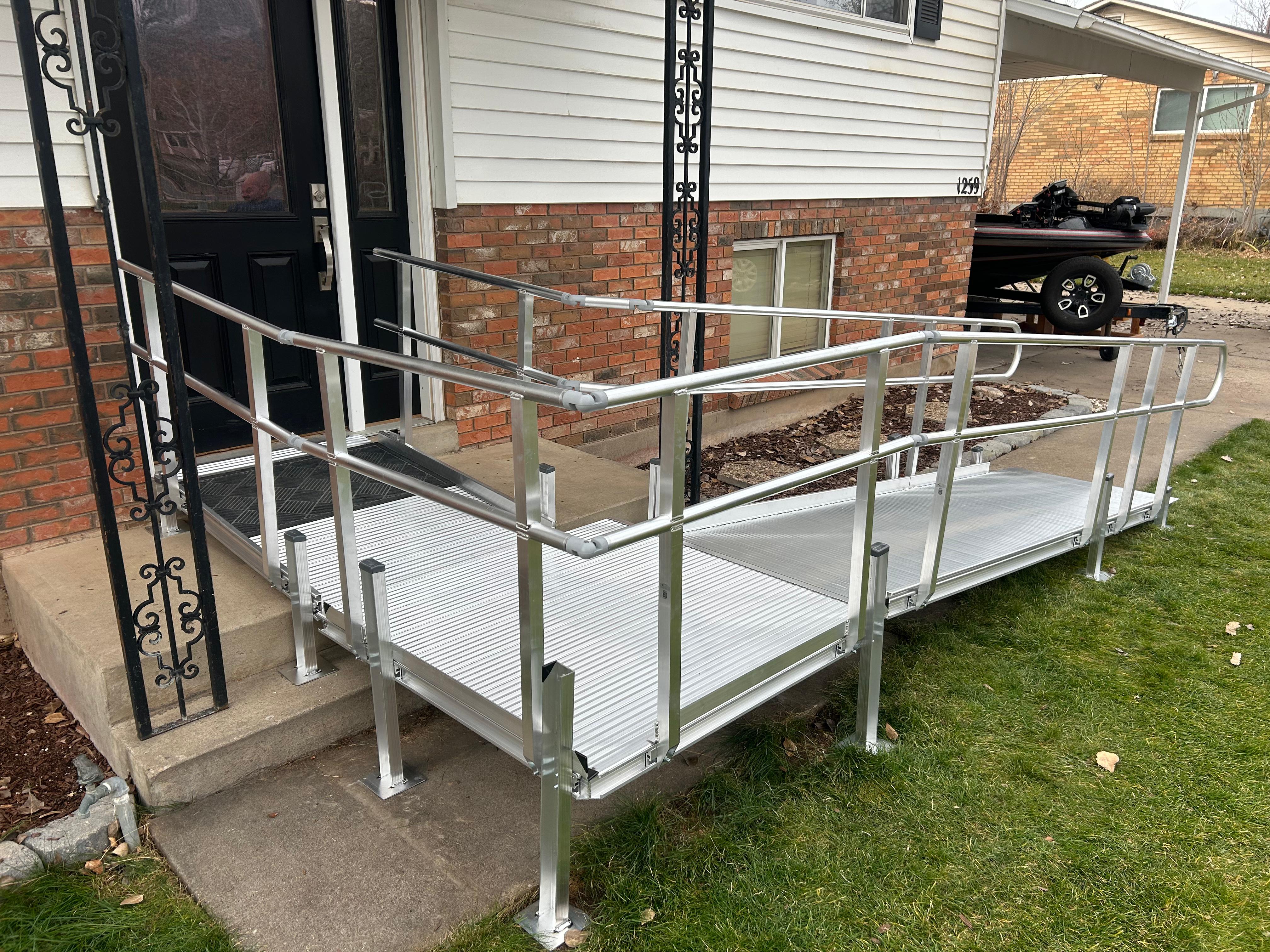
We install two National Ramp systems, and the difference between them shows up most in December.
Liberty Aluminum Solid Surface gives you a continuous deck with a slip resistant finish. It is the better surface for small front casters, canes, and walker tips, because there is nothing to catch on and nothing to drop into. The tradeoff is that snow and water sit on it. What falls on a solid surface stays there until someone moves it or it melts, and what melts can refreeze.
Breeze Series Aluminum Mesh is an open mesh deck. Light snow and rain pass through it instead of pooling on top, so it tends to hold less standing water and clears faster when someone does sweep it. The tradeoff runs the other way: an open mesh surface is less forgiving of very small wheels, and some people simply prefer the feel of a solid deck underfoot.
Neither one is the right answer for every home. If the ramp is in full shade, at the bottom of a north facing entry, and nobody is going to be out there with a broom at six in the morning, the mesh deck does more of the work for you. If the ramp gets afternoon sun and the person using it is on a chair with small front casters, solid surface is usually the better call. It is worth saying out loud at the evaluation rather than discovering it in January.
Use the Right Ice Melt, Not Just Any Ice Melt
Modular ramps are aluminum, top to bottom. That is what makes them last, and it is also what makes the wrong de-icer expensive.
Ordinary rock salt and calcium chloride, the bags stacked by the door at every hardware store in the valley, are corrosive to aluminum. You will not notice anything the first winter. What you notice around year three or four is pitting on the deck surface, white powder around the fasteners, and staining that does not come off.
Use a pet safe ice melt instead. It is what we tell every customer to buy, and it is the part of this list we would least like you to skip. It genuinely clears the deck, which sand never really does, and it will not attack the aluminum the way rock salt does. Buy a bag now and put it by the door, so it is there before the first storm rather than the morning after it.
Clear It Without Wrecking It
A steel shovel blade on an aluminum deck scrapes off the slip resistant finish, which is the exact surface you are relying on. Once it is gone, it does not come back.
A stiff broom handles most of what falls in a Utah or Idaho winter, and a plastic shovel handles the rest. Clear it early rather than late. Six inches of fresh powder sweeps off in two minutes. The same six inches after someone has walked up and down it twice is compacted ice that has to be chipped, and chipping is where the damage happens.
Do the handrails too. Handrails are what someone grabs at the moment they lose their footing, and a glazed handrail is no help at all.
Slope Matters More in Winter Than in Summer
ADA guidance calls for a maximum slope of one inch of rise for every twelve inches of run. Our ramps are configured to meet that, and on a dry day a slope a little steeper than that would still feel manageable to most people.
Ice removes that margin entirely. On a properly sloped ramp, an unexpected slip is recoverable. On a steeper one, gravity has already won before anyone can react, and the person in the chair has no way to stop.
This is the main reason a ramp that was thrown together to the length the yard happened to allow becomes a real problem in winter, and why the run length is not the place to economize. If you are unsure what your current ramp actually measures, it is worth putting a level on it before the weather turns.
Watch Where the Water Comes From
The ice that causes trouble is usually not the snow that fell on the ramp. It is meltwater that arrived from somewhere else and froze where people step.
Look up. If the roof edge or a gutter discharges over the top landing, every sunny afternoon sends a small stream onto the exact square yard where someone stops, opens a door, and turns a chair. That water refreezes overnight into a patch of clear ice right at the threshold, which is the worst possible place for it.
Redirecting a downspout or adding a short gutter extension before winter is a cheap fix that eliminates the problem. Check the bottom landing for the same thing, especially where a driveway slopes back toward the house.
A Fall Checklist
- Sweep the deck clear of leaves and grit, and check nothing has worked its way into the panel joints
- Walk the full run and check that every leg is still firmly seated, since a season of freeze and thaw can shift ground under a footing
- Check handrails for anything loose
- Look at roof lines, gutters, and downspouts above both landings, and redirect anything discharging onto them
- Put a bag of pet safe ice melt, a stiff broom, and a plastic shovel where they are actually reachable from the door
- Confirm the path from the bottom of the ramp to the driveway is part of whoever clears your snow, not an afterthought
If You Are Planning a Ramp This Fall
Two things change once the ground freezes hard. Setting footings gets harder, and the window for comfortable scheduling narrows as everyone else has the same realization at the same time.
Modular aluminum ramps go in faster than most people expect. The panels are configured on site to your rise height and footprint, most residential installs finish in a single day, and because the system is modular rather than poured or framed, there is no concrete to cure and no damage to your landscaping. It is also removable and reconfigurable later if the need changes.
If you are weighing it up, our guide to modular ramp costs covers what drives the price, and choosing the right modular ramp for long term accessibility covers configuration.
Frequently Asked Questions
Can I use rock salt on an aluminum ramp?
No. Rock salt and calcium chloride corrode aluminum over time, and the damage shows up as pitting and staining a few winters in. Use a pet safe ice melt instead. That is what we recommend to every customer, and it clears the deck without doing that damage.
Is sand good enough instead of ice melt?
Sand gives you a bit of grip, but it does not melt anything, so the ice underneath stays where it is and you are relying on a thin layer of grit over a hard surface. A pet safe ice melt actually removes the problem instead of covering it, which is why it is what we recommend.
Does a mesh ramp really stay clearer than a solid one?
It tends to hold less standing water and snow, because precipitation can pass through the deck rather than sitting on top of it. It still needs sweeping after a real storm. The mesh reduces the work, it does not remove it.
Will a modular ramp handle the weight of snow on it?
Yes. These are structural aluminum systems built for daily use by wheelchairs, scooters, and walkers year round, and accumulated snow is well within what they carry. Clearing it is about traction for the person using the ramp, not about protecting the ramp.
Is it too late in the season to get a ramp installed?
Usually not. Most residential modular ramps install in a single day and need no concrete work, so the timeline is driven by getting the site measured and the configuration ordered rather than by the weather. The earlier in the fall you start, the easier the scheduling.
What about a portable ramp for winter?
Portable and folding ramps have their place for short rises and temporary needs, and you can see the options on our portable ramps page. For a primary entrance used every day through a full winter, a permanently installed modular system with handrails is the safer choice.
The Bottom Line
Winter does not break ramps. It exposes decisions that were made earlier: the surface that was specified, the slope that was accepted, whether anyone looked up at the gutter above the landing, and what ends up in the bag by the door.
Sort those out in September and the ramp stays a non event through the whole season. If you would like someone to look at your entry and tell you honestly how it will behave once the weather turns, book a free in home evaluation and we will walk it with you.