Table of Contents
If your staircase has an open run and you can build a permanent shaft or a porch platform, vertical platform lifts (VPLs) are usually the right call. If your staircase is enclosed, finished, and shared with other people in the home, an inclined wheelchair lift for stairs is faster to install and easier to live with.
That is the short version. The rest of this guide walks through cost, footprint, code requirements, and the specific situations where one option beats the other.
A quick note on names. A VPL is sometimes called a porch lift. An inclined wheelchair lift for stairs is sometimes called an inclined platform lift or an IP lift. Same products, different names depending on who you ask.
Western Stairlifts installs both across Utah, Idaho, and Arizona, so this comparison is written from firsthand experience helping families pick the right one. If you would rather skip the reading and just get a straight answer for your staircase, a free in-home evaluation gets you that without any pressure to buy.
What Is a Vertical Platform Lift (VPL)?
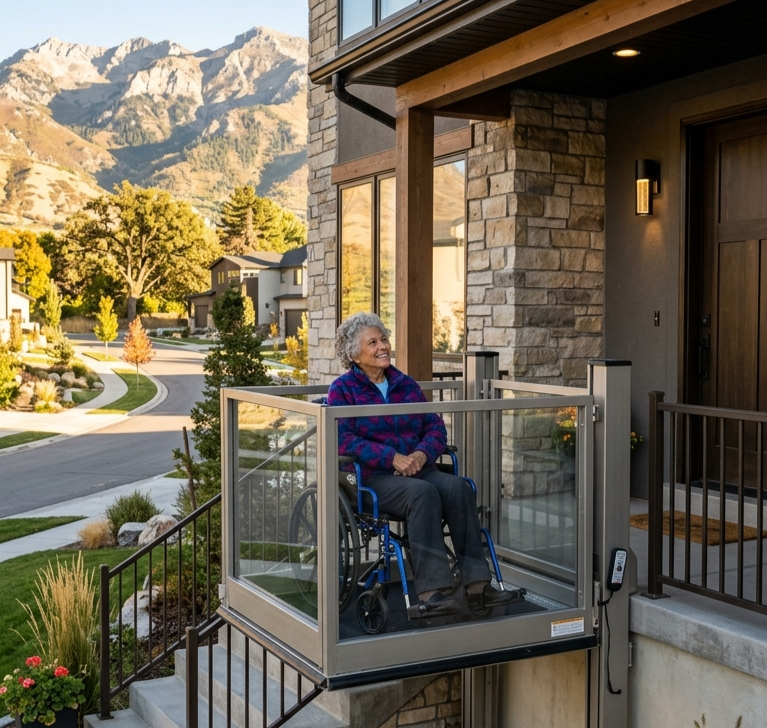
A vertical platform lift, or VPL, is an open platform about the size of a wheelchair that rises straight up, or along a short incline, inside a small gated enclosure. Think of it as a compact, code-built lift for outdoor entries and short indoor runs.
VPLs are the best fit for porches, decks, garage-to-house entries, and any short straight run where a long wheelchair ramp is not practical or does not fit the available space. Most residential VPLs lift between 4 and 14 feet.
Footprint matters here. A standard VPL needs roughly a 5-by-5-foot level pad plus 6 to 8 feet of vertical clearance. An inclined VPL, which travels along a short ramped rail instead of straight up, needs more room: plan on 12 to 25 feet of combined ramp and vertical travel.
VPLs carry loads up to 750 pounds, which makes them a solid match for power wheelchairs and scooters that are too heavy for other options.
On code: many residential VPL installs fall under IBC (International Building Code) private residence requirements, which are less involved than commercial code. Commercial installs, like a lift at a business entrance, usually need permits and inspections.
Installed cost in our region runs $8,000 to $20,000 or more, depending on rise, site work, and electrical needs. Every Western Stairlifts VPL install includes a site assessment, permitting where required, and a 12-month service warranty. Plan on a biannual inspection and battery replacement every 3 to 5 years to keep it running. Most porch-lift installs we do along the Wasatch Front and in Boise land in the $10,000 to $14,000 range once permitting and site work are included.
If your entry only needs to clear a single step, a full VPL may be more than you need. Our guide to wheelchair ramps covers the simpler option.
What Is a Wheelchair Lift for Stairs?
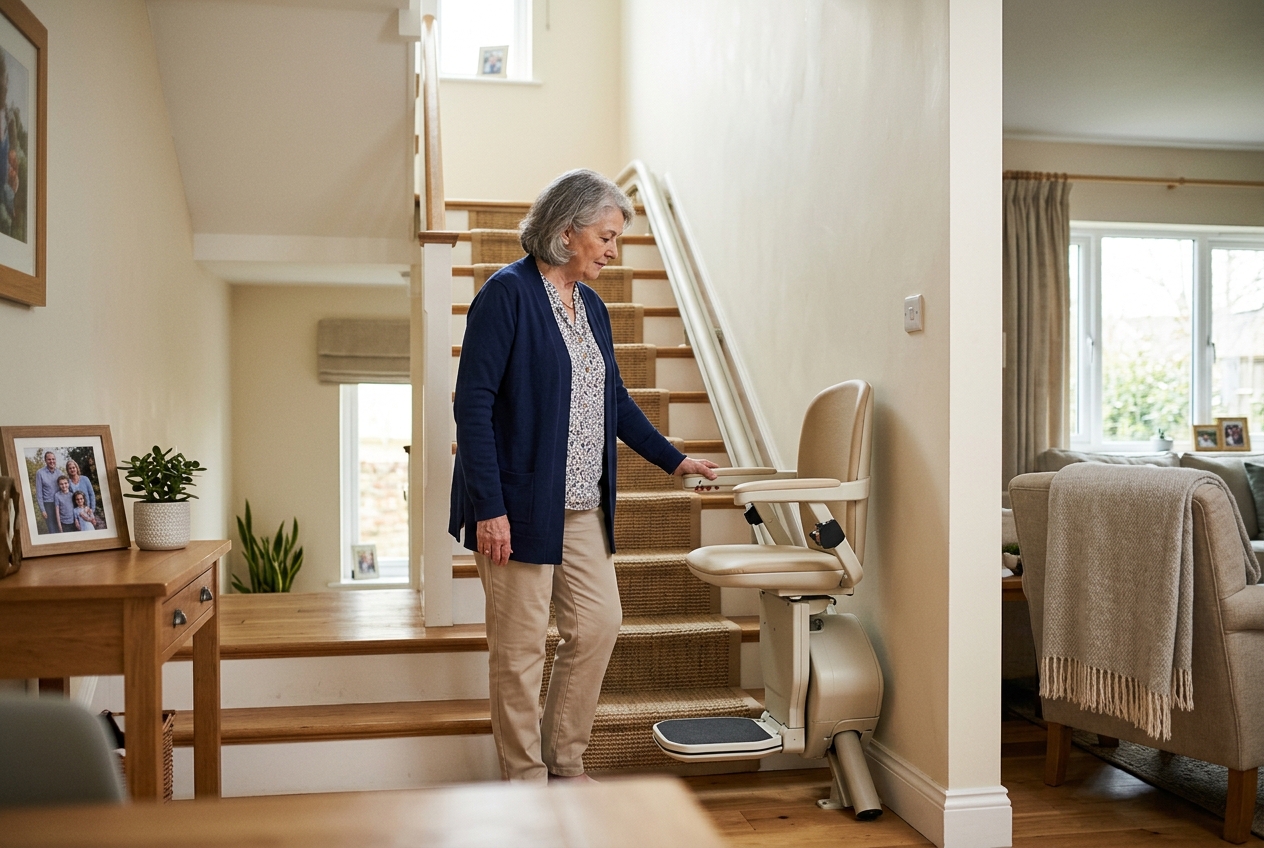
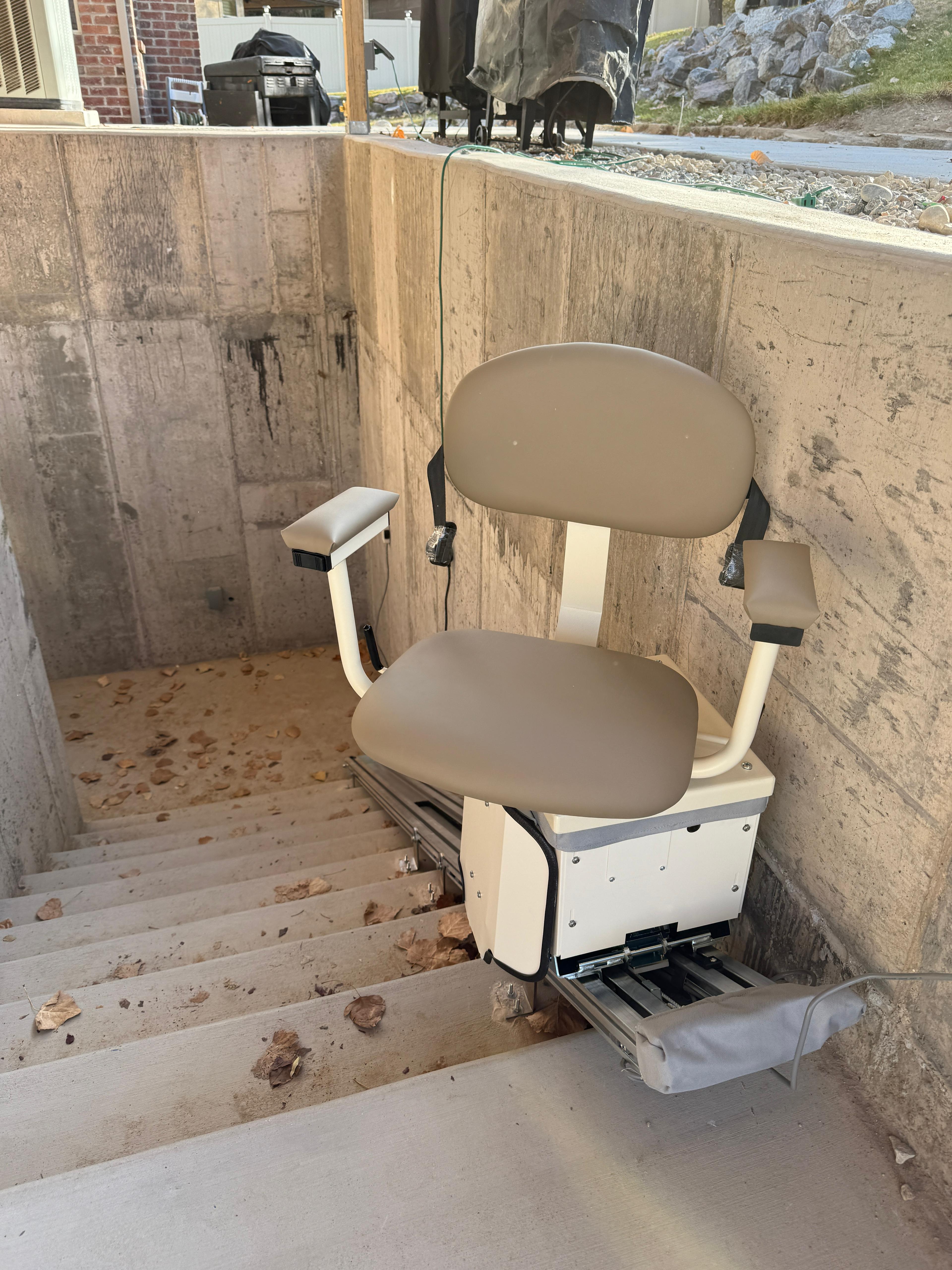
A wheelchair lift for stairs, also called an inclined platform lift or a wheelchair stairlift, is a motorized platform that rides along a fixed rail mounted directly onto an existing staircase. The platform folds flat against the wall when it is not in use, and folding arms with a safety cage keep the rider secure during travel.
This is the right category when a permanent shaft or ramp is not feasible: enclosed staircases, finished interiors, split-level homes, or any situation where you cannot change the floor plan to add a shaft. Because the lift mounts to the stairs you already have, there is no new structure to build.
Load capacity runs 500 to 750 pounds depending on the manufacturer and model, which covers most manual and power wheelchairs used indoors.
On code, these units are typically classified as stairway chairlifts for accessibility purposes under ICC A117.1 and ADA (Americans with Disabilities Act) residential guidance, which is more forgiving than the stricter ADA commercial standard applied to public buildings.
Installed cost in our region runs $5,000 to $15,000 or more. Every Western Stairlifts installation includes a home survey, a custom rail built to match your stairs, coordination for the electrical hookup, and the same 12-month service warranty we put on VPLs.
Maintenance follows the same biannual cadence as a VPL, with one addition: because the lift rides on rails bolted to your stairs, we check rail cleanliness and bolt tightness at every visit. Split-level homes from Sandy to Meridian and Mesa are where inclined lifts really earn their keep, since those stairwells rarely have room for a full VPL shaft.
VPL vs. Wheelchair Lift for Stairs: Quick Comparison
VPL vs. Wheelchair Lift for Stairs
A quick side-by-side to help you narrow down the right access solution before your free in-home evaluation.
| Feature | Vertical Platform LiftStraight up and down | Inclined Wheelchair LiftFollows your stair rail |
|---|---|---|
| Best for (home type) | Porches, decks, garage entries, short outdoor runs | Enclosed, finished interior staircases, split levels |
| Vertical travel / rise | 4 to 14 feet | Matches your existing staircase, most homes have 8 to 14 feet |
| Footprint needed | 5x5 ft pad plus 6 to 8 ft clearance (12 to 25 ft ramp plus vertical for an inclined VPL) | Rails mount to your existing stairs, and the platform folds against the wall when not in use |
| Typical load | Up to 750 lbs | 500 to 750 lbs |
| Installed cost band (Utah, Idaho, Arizona) | $8,000 to $20,000 or more | $5,000 to $15,000 or more |
| Install time | 4 to 6 weeks from consult to install, longer if site prep or permitting is needed | 4 to 6 weeks from consult to install, often on the shorter end since no new structure is built |
| Permits usually required | Often, especially with electrical or concrete work | Rarely, but always confirm with your local building department |
| Power outage operation | Battery backup standard on most models for a limited number of cycles | Battery backup standard on most models for a limited number of cycles |
| Ideal user (chair / scooter / walker) | Power chairs and scooters, for users who need full turning room | Manual chairs, and users who transfer from a walker for short distances |
| Maintenance cadence | Biannual inspection, battery replacement every 3 to 5 years | Biannual inspection, plus rail cleaning and bolt check |
Not sure which lift fits your home? Our free in-home evaluation will confirm the right solution.
Which One Do You Need? A Simple Decision Guide
The fastest way to decide is to match your situation to the list below.
Outdoor porch or deck with more than one step. A VPL almost always wins here. It is built for exactly this: a small footprint, a weatherized platform, and no need to disrupt your existing entry.
Garage-to-house entry with a 3- to 5-foot rise. VPL, no contest. This is one of the most common installs we do, and an inclined lift does not apply since there is no staircase to mount rails to.
Interior staircase that is finished, narrow, and enclosed. An inclined lift is the better fit. It works with the stairs you already have instead of asking you to open a wall or pour a pad.
Split-level home with less than 8 feet between floors and no available shaft. Same answer: an inclined lift. There usually is not enough clear space for a VPL shaft in a tight split-level stairwell.
The user is a power chair or scooter up to about 300 pounds. Either option can work, but a VPL is easier to live with day to day, since the rider drives straight on and off without transferring.
User transfers to a manual chair or walks with a walker for short distances. An inclined lift is the lighter install and often the lower-cost option, since the rider is not always driving a full-power chair onto the platform.
Rental property, or you want a future tenant to use it without training. VPL. An open platform is more intuitive for someone who has never used the equipment before.
You need to keep the staircase usable for everyone else in the home. Inclined lift. The platform folds flat against the wall, so the stairs stay clear for the rest of the household.
If more than one of these applies to your home, that is normal. Most families end up choosing based on whichever factor matters most to them: budget, install speed, or day-to-day ease of use. Our in-home evaluation is built to help you weigh those trade-offs against your actual staircase, not a generic spec sheet.
The Cost Side Nobody Warns You About
Sticker price is only part of the budget. A few line items catch people off guard.
Permit fees in Utah, Idaho, and Arizona typically run $200 to $900 for a residential install, more for commercial projects.
Electrical work adds up differently depending on the lift. A VPL often needs a dedicated 240V circuit, while most inclined lifts run on standard 120V. Sub-panel work in our market runs $500 to $1,500 when a dedicated circuit is required.
Site prep for an outdoor VPL usually means a 4- to 6-inch concrete pad, which runs $1,000 to $2,000 depending on access and grading.
After your warranty ends, budget $200 to $400 per year per unit for maintenance.
None of this is a reason to guess. Western Stairlifts includes a free in-home site assessment with every quote, so you get real numbers for your actual staircase or entry before you commit to anything. If a ramp turns out to be the better fit for your budget, our breakdown of wheelchair ramp cost covers that option too.
Frequently Asked Questions
How much does a vertical platform lift cost in Utah? Most residential VPL installs in Utah run $8,000 to $20,000 or more, depending on rise, site work, and electrical needs. We size the exact cost during a free in-home visit. Call 801-386-2408 to book yours.
Is a vertical platform lift covered by Medicare or insurance? Original Medicare generally does not cover VPLs or inclined lifts, though some Medicare Advantage plans, VA benefits, or state programs may help with part of the cost. We recommend checking with your specific plan before you budget. Call 801-386-2408 and we can point you toward resources we have seen work for other families.
How long does it take to install a VPL? Lead time typically runs 4 to 6 weeks from your in-home consultation to a finished install, though permitting or site prep can extend that. We will give you a firm timeline after the site visit. Call 801-386-2408 to get on the schedule.
Can a wheelchair lift for stairs be used on a narrow staircase? In most cases, yes. Inclined lifts mount directly to your existing stairs, and the platform folds flat against the wall, so they work in tighter stairwells than a VPL shaft would allow. We confirm the fit with measurements during your free in-home visit. Call 801-386-2408 to schedule one.
Do these work during a power outage? Most VPL and inclined lift models include a battery backup that will run the unit for a limited number of cycles during an outage. The exact runtime depends on the model, and we will confirm the spec for whichever unit fits your home. Call 801-386-2408 for details on the models we carry.
What is the difference between a VPL and a wheelchair lift? A vertical platform lift travels straight up, or along a short ramp, inside its own small enclosure, and works well for porches, decks, and short outdoor runs. An inclined wheelchair lift for stairs rides along a rail mounted to your existing staircase. Call 801-386-2408, and we will help you match your home to the right one.
Does a VPL require a permit in Utah or Idaho? Often, yes, especially when the install involves new electrical work or a concrete pad. Requirements vary by city and county, so we confirm what applies to your address before we quote the job. Call 801-386-2408, and we will handle the permit question for you.
How much weight can a residential wheelchair lift hold? Most residential inclined lifts hold 500 to 750 pounds, depending on the manufacturer and model. If you need a higher capacity, a VPL rated up to 750 pounds may be the better fit. Call 801-386-2408, and we will match capacity to your equipment.
The 30-Second Answer
Here is the short version, one more time. A vertical platform lift wins outdoors and on short rises: porches, decks, garage entries, anywhere a shaft or short ramp fits better than a staircase rail. An inclined wheelchair lift for stairs wins indoors, on the staircase you already have, especially in finished or split-level homes. Both handle rises under 14 feet, and both are Western Stairlifts' bread and butter across Utah, Idaho, and Arizona.
If your rise is taller than 14 feet, or you are moving between more than two floors, a full home elevator is worth a look instead.
The fastest way to know which one fits your home is to see both in person. We offer a free in-home evaluation anywhere in our Utah or Idaho service area, and we bring both products to the consultation so you can compare them side by side in your own home.
Call 801-386-2408. Hours are Monday through Friday, 8:00 AM to 5:00 PM. Closed Saturday and Sunday.
Related reading: Wheelchair Ramp vs. Lift: What's Better for Outdoor Access